Tag Archives: I Like it

Lana Lane

Lana Lane is a North American rock singer. She sings lead in her eponymous band, and has sung backing vocals for the band Rocket Scientists and guest sung on Ayreon and Erik Norlander albums.

She is married to music producer Erik Norlander, who co-produces her albums with her at their own studio, Think Tank Media in Woodland Hills, California.

Her first album Love is an Illusion was released in 1995 and obtained a fair amount of success in Japan, as did Curious Goods – her second album, from 1996.

Lady Macbeth is a collection of songs based on William Shakespeare’s tragedy Macbeth, from Lady MacBeth’s point of view.

Lana Lane appeared as a guest vocalist on two Ayreon CDs, Universal Migrator Part 1: The Dream Sequencer and Universal Migrator Part 2: Flight of the Migrator, singing lead and harmony vocals. She also provided the computer voice for both albums.

In 2003 Lana sang the part of Queen Guinevere on the concept album Once and Future King Part I by Gary Hughes.

Secrets of Astrology (2000)
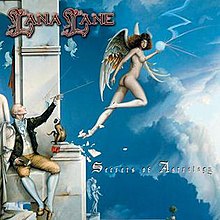
 

This was the first album from this group of musicians I purchased. The samples sounded interesting and I was intrigued by the cover. This was certainly a musical style I could relate to. I could hear a resemblance to the work a decade before of E.L.O.

Those strings and full harmonies and melodies. The album starts off quietly, a simple theme repeated with instruments slowly added (like Tubular Bells). Then, after several minutes a machine gun-like drum set kicks in. From then on until the end it’s flat out heavy, symphonic rock. There is no arguing with Lana’s title as “Queen of Symphonic Rock”. She is often compared to the Wilson girls from Heart. But as Heart is not a band I know a lot about, I can’t compare her to anyone.

While there are technically better singers, Lana has a powerful voice that rises to her husband, Erik Norlander’s songs. As for the cover, it is by Michael Parkes, one of my favourite painters. His work features in other albums by Lana and Erik. Erik even uses an image by Sci-Fi illustrator Jim Burns I am familiar with on his ‘Seas of Orion’ CD.

Love is an Illusion (1995)

After the first Lana Lane CD, I was hooked. I set out to get her remaining albums.

Her first album starts with someone tuning a radio. This changes to a choral effect then the title song’s main theme. The second track starts the song, Erik Norlander plays all the keyboards and propels the fast tempos along, ably assisted by Don Schiff (Chapman Stick) and Tommy Amato (drums).

Things slow down for the mid-tempo song “Coloured Life”. A good song with nice interplay between the keyboards and guitars. “Cold Outside” starts with a heavy metal guitar and assured rhythm section. In the chorus Lana gets to stretch out, he voice sours over the arrangements there is a catchy melody easily remembered after the album finishes.

“Through the Fire” is another song with all the necessary elements; chugging guitars, rock steady drumming, again that soaring voice and plenty of progressive elements to keep it interesting. Keyboards dominate in the foot tapping “Through the rain”, containing a good dose of swing rhythms.

“Faerie Tale State of Mind” dates from 1993, a nice ballad with grand sweeping orchestral effects. “Dream Burning Down” is more of a by-the-numbers heavy rock tune. “Can’t find My Way Home” looses its way a bit in the verses, but redeems itself with a strong chorus.

The album was re-mastered in 1998 by Erik, which wasn’t really necessary. The original is far better than must albums in the genre and he should be happy with the result.

This first album isn’t a heavy and overwhelming as latter albums. I suspect (like most first albums) that he had a good number of well rehearsed songs ready for recording.

This remains a favorite of mine in her discography and despite the above comments, I usually play the 1998 version with it’s fuller sound.

Curious Goods (1996)

With her second album, Erik and Lane had to prove they could do it again.

Although not the greatest Lana Lane album, it does have some of her best songs. A sample of ‘Eschers’s Staircase” sparked initial interest in her work. This is a great progressive rock song, with a strong chorus and nice instrumental breaks. It has a great driving bass line throughout most of the song.

The other good song is “Symphony of Angels” that merges fast guitar riffs with slower keyboard passages. At over six minutes, there is lots of scope for variations in the arrangements and tempo.

Erik Norlander is becoming a better composer and arranger although the material here is not as strong as in the next two albums.

Garden of the Moon (1998)

According to Erik Norlander, this album ten times the number of the two previous album. It’s not surprising, this is a harder, more rocking band that provides Lana with a consistent wall of sound throughout the album. The second track, “Destination Roswell” is a six minute radio friendly song with hit potential.

Things do slow down for the excellent “Under the Olive Tree”. Again a great symphonic song with some nice guitar solos.

The title tune is an Erik Norlander instrumental that could have come from a Rocket Scientists album.

This is perhaps the most commercial hard rock album of them all, but for me the best was yet to come.
New Opera

I’m not a fan of Opera, but there is a certain grandeur in those thundering chords, over the top string arrangements and some poor soprano trying to hold her own above it all. In the last 10 years there has emerged a marriage of rock and opera styles. Retaining the sound weight of an orchestra and adding drums, bass and metal-style guitars here is the new breed of operatic albums.

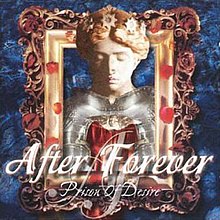
After Forever – Prison of Desire (2001)

They are often called ‘gothic metal’ and lumped in with artists like Nightwish and Edenbridge. But this album is different, where the other bands sound like a rock outfit with strings attached, this is the other way around. The compositions have a definite symphonic structure.

Throughout each song the themes and melody can change, often the percussion stops to allow the strings to take over. And on top of this is the voice of Floor Janseen. There are male grunts, characteristic of ‘gothic metal’, but here they are used sparingly and don’t overpower the orchestrations. This is big, bombastic and completely over the top, which is why I like it.


Aesma Daeva – The Eros of Frigid Beauty (2001)

As you can see from the cover, it looks like a CD of medieval music, possibly baroque. The trumpet fanfare that opens the albums confirms expectations, then comes a heavy metal guitar and crashing drums. A clear soprano voice sings among the musical spaces This is definitely not something by J S Bach. Further investigations reveal that John W Prassas II wrote all the songs. With a website named http://www.rootofallevil.com things may be a bit heavier than expected. Instruments include french horn, violin, flute, trombones and what sounds like a harpsichord.

The difference with this album is that not every instrument has to be present in every track at all times. Often things get very quiet and ambient, then slowly the intensity and volume increases. There are wide dynamics in most of the tracks and all of them have female vocals. Because of the wide variations in style, it’s difficult to categorize the album as a whole. Definitely something for the more adventurous listener.

Therion – Vovin (1998)

Therion (Greek for Beast) was first known as a Swedish Metal band when it was formed in 1990. The first albums contained male grunts and offered little different from most metal bands. Then in 1996, with Theli things changed. A string orchestra was added. Male and female choirs probably more acquainted with Handel joined the production.

Symphonic speed metal comes to life on Vovin.

Bandleader Christofer Johnsson fashioned a hybrid that displays how the potent elements of the two divergent genres can be fused. The recording is cohesive and robust, the strings, choral singers, and band merge together perfectly.

The emphasis is mainly on the musical arrangements of the orchestrations and choirs. The impression I get is that the guitars and percussion was added later. Classical music with heavy metal influences never felt so good.

Other surprises include the scarcity of rock vocals throughout and the charming Middle Eastern overtones found on the opening track, “The Rise of Sodom and Gomorrah.”

“Birth Of Venus Illegitima” is a more absorbing musical experience. The shifting between the low voices and the higher soprano/alto voices is a very nice touch.

“Clavicula Nox” has beautiful female lead vocals and acoustic guitar solos.

“Black Sun” and “Draconian Trilogy” uses a foreboding piano-line surrounded by gothic orchestration to create memorable songs.


New Symphonies

The orchestral symphonic form has been with us for several centuries, from Bach through Beethoven and Berloiz. Composers have used a long form of music to express themes and musical ideas that can range from a ten minute suite to excessive works that fill the best part of a day. Just because orchestral music has fallen from favor as popular music doesn’t mean it has been abandoned. Modern orchestral composers are now best known for film music. But the old tradition continues with other musicians……

Steve Hackett – A Midsummer Night’s Dream (1997)

Steve Hackett may be a great guitar player, but the reason he is not on my ‘Guitar Gods’ list is that he is an even better composer. Through his long career, he has performed a wide range of music. From Genesis to his solo works there is always a freshness and originality that shines through.

This album is similar to ‘Bay of Kings’ from 1983. Just Steve, an acoustic guitar and musical accompaniment. Here, the small orchestra on its own could be playing anything from the romantic period. The music is lyrical and sweet (but not too much). Then, when the theme seems exhausted, the guitar enters and continues the tune. Although there are 13 tracks from two to six minutes in length, comprising just over an hour, they all merge together to form one complete work.

Anyone who likes the guitar concertos of Villa-lobos or Rodrigo will like this. It’s modern with a wonderful warmth and glow that will remind you of compositions from years ago.


Get Smart

Get Smart is a 2008 American adventure and action comedy film which was directed by Peter Segal, written by Tom J. Astle and Matt Ember and produced by Leonard B. Stern, who is also the original series’ producer. The film is based on Mel Brooks and Buck Henry’s 1960s spy parody television series of the same name.

The film stars Steve Carell, Anne Hathaway, Dwayne Johnson and Alan Arkin, and co-stars Terence Stamp, Terry Crews, David Koechner and James Caan. Bernie Kopell, who played Siegfried in the original series, also appeared in the film. The film centers on an analyst named Maxwell “Max” Smart (Carell) who dreams of becoming a real field agent and a better spy. The film was theatrically released on June 20, 2008 by Warner Bros. Pictures.

For a ‘comedy’ it’s not that funny. Carell’s playing it as a straight man just doesn’t work. The best part-laughs are the pratfalls and visual humour. Towards the end there is some decent action and stunts. Very Average (3/5).

Goat Staring

The Men Who Stare at Goats (film)

A 2009 British-American war parody comedy film directed by Grant Heslov. It is a fictionalized version of Jon Ronson’s 2004 book of an investigation into attempts by the U.S. military to employ psychic powers as a weapon. The film stars George Clooney, Ewan McGregor, Jeff Bridges and Kevin Spacey, and was produced by Clooney’s and Heslov’s production company Smokehouse Pictures.

Based on the book by Jon Ronson.

Very strange film about a duo (Clooney & McGregor) who go on an Iraq war road trip. During the trip McGregor narrates, telling the story of the US army’s attempts to use psychic powers in warfare since the 1960’s. Very strange and a commentary on the weird things done in the military.
(3/5)

Lunar Chronicles

The Lunar Chronicles
by
Marissa Meyer

Lunar

#1 Cinder
Cinder, a gifted mechanic, is a cyborg. She’s a second-class citizen with a mysterious past, reviled by her stepmother and blamed for her stepsister’s illness. But when her life becomes intertwined with the handsome Prince Kai’s, she suddenly finds herself at the center of an intergalactic struggle, and a forbidden attraction. Caught between duty and freedom, loyalty and betrayal, she must uncover secrets about her past in order to protect her world’s future.

#2 Scarlet
Cinder, the cyborg mechanic, returns in the second thrilling installment of the bestselling Lunar Chronicles. She’s trying to break out of prison—even though if she succeeds, she’ll be the Commonwealth’s most wanted fugitive.

#3 Cress
Having risked everything to warn Cinder of Queen Levana’s evil plan, Cress has a slight problem. She’s been imprisoned on a satellite since childhood and has only ever had her netscreens as company. All that screen time has made Cress a great hacker. Unfortunately, she’s just received orders from Levana to track down Cinder and her handsome accomplice.

#4 Winter
Princess Winter is admired by the Lunar people for her grace and kindness, and despite the scars that mar her face, her beauty is said to be even more breathtaking than that of her stepmother, Queen Levana.

A science fiction re-telling of the Cinderella story. The first three books are fun and full of adventure. Unfortunately the final book is over 200,000 words and just too long with too many characters and plot lines. Recommended, but be ready for a slog through the final book.


2004 Film Reviews

Film Reviews from Film Appreciation Course Feb/Mar 2004

As a result of these classes I have moved from being un-informed and ignorant to informed and stupid. So here it is…..
For my records and your reading, a quick review of the films viewed and, as is the convention, a rating for each.

Nobody’s Business
Before seeing this film, I always regarded the documentary style as being more suited to TV. However this film prompted me to see “The Fog of War”. This film only succeeds due to Alan Berliner’s mix of cinematic styles, all gel to form a compelling narrative of his cranky father. An enjoyable movie with a old man in a starring role you are not likely to forget quickly.

Rating 7/10

The Man with a Movie Camera
This was a surprise for me. I didn’t believe that any film from 1929 could be so inventive and “modern”. Even now it has relevance in a western post-industrial society. It just shows how little most of our lives have changed. It’s just a great kaleidoscope of shapes and movement.

But most of all, I liked the music. The film shown had a soundtrack by “The Alloy Orchestra”, I have since found another by “The Cinematic Orchestra” which I own. And recently found another by the group “Biosphere”, it’s the second disk on their “Substrata V.2” album (available on Spotify).

Rating 9/10

Amelie
I had never heard of this film before seeing it. It’s mix of day-glow colours and computer animations form a wonderful stylistic whole.

One scene that remains in my memory is when Amelie is skimming stones. The camera starts behind her, arcs over and after almost 180 degrees ends in front of her. The camera movement is similar to Peter Jackson’s films, both often have the viewpoint up high, with the camera sweeping down to the subject in detail.

Best of all is it’s witty and often dark humour. I didn’t think I would enjoy a film where I had to _read_ all the dialogue. This one goes on my list of “Best Films Ever”. Perfectly formed.

Rating 10/10

Heavenly Creatures
I had seen this film when it was first released and later when it was screened on TV. This is the film where you can see Peter Jackson for the first time as a world class director. He manages to keep the pace of the film going at the right speed, varying where necessary and reaching a slow build-up of tension towards the end. This despite knowing what the end will be from the very beginning.

His mastery of the medium displayed in this film I’m sure is what gave New Line the confidence to spend 200-300 million and 8 years on the biggest film trilogy of all time.

It would be a mistake to make direct comparisons to the other Jackson films. I have read a biography of Peter Jackson and it is clear that his partner Fran Walsh was a big influence in Peter making this film and in it’s execution. I think this is better than his later film “The Frighteners”.

Rating 10/10
(Jacksons second best film to LoTR)

400 Blows
Grey, bleak, dull and boring sum up this movie for me. I can’t believe this could be enjoyed by anyone except for the directors friends and family (including his parents).

This film starts off slowly and gradually progresses to something even slower and duller. I was not impressed, I couldn’t even keep awake and missed 10-20 minutes near the end due to falling asleep. Did anything happen ?

Rating 0/10 (recommended for insomniacs)

Dancer in the Dark
I’m sure that one of the first things they teach in film school is…… hold the camera steady to get a good shot. Avoid sudden movements, quick panning and excessive zooming. In the first five minutes of this film, all the above “rules” were broken. There is a photo in the biography of Peter Jackson, it shows him with a custom made rig to hold the camera steady. Peter went to a lot of trouble to get a steady camera, something Lars von Trier hasn’t bothered with in this film. At first I thought it was some sort of cheap introduction, I can understand using a hand-held camera to enhance movement and intensity. Jackson does this at the end of “Heavenly Creatures” and it works. In this film it doesn’t, if this is “experimental” then the experiment failed. If it’s part of the “style” then it completely undermines the telling of the story. And what is worse is that after 20 minutes I was starting to get a headache.

I actually like Bjork’s music (I have most of her albums), but as an actor she is not very engaging. There were no characters I could relate to and story of minimal interest. I liked the musical numbers (here the cameras were nailed down !) as they added a lightness and diversion to an otherwise below average movie.

I hope that next time, the director employs a better camera operator.

Rating 0/10 (for the headache)

Casablanca
I saw Casablanca for the first time on TV several years ago. So I was a bit surprised to find the film in black and white. I presume this is one of the films given a dash of colour at a later date. When I first saw the film, I thought it was about a “femme fatale” who manipulates men to her own advantage. Seeing the film again my opinion is unchanged.

Ingrid Bergman is, as usual, stunningly beautiful and succeeds in her escape mission; have you ever seen a beautiful woman ask a favour of a man and not get one ?
She does manage to string two seemingly intelligent men along for most of the film, putting on the charm when necessary.

It may also be that I just can’t relate to Bogart as the “Hero”. He doesn’t look or act like one, he looks more suited to a Hollywood gangster movie (and as the bad guy). The best character was the French policeman.

There is no doubt that the film succeeds in atmospherics and style.

I do find it amusing that critics think the film makes a lot of references to other cultural references like Huck Finn, Washington etc. and see it as propaganda. I think the general public would not see anything beyond the story. Or perhaps it’s just that I am not American.

Still, a good story and enjoyable. Even if it just perpetuates the myth that the Pretty Women always get what they want.

Rating 6/10

Goldiggers of 1935
The musical numbers have a great style and panache, mixing conventional and experimental film making techniques. The remaining story was a bit of a cliché of goof-ball comedies of the period. It did have wit and a dry humor that kept the story going. But ultimately it’s the musical numbers (especially those pianos) that remain as memories of the film.

Rating 6/10

Citizen Kane
I can see why this film is appreciated by those in the film industry. It sets a lot of standards for others to follow. I don’t know what all the fuss is about “Rosebud”, it’s clear to me that the sled represents the memories of Kane as a child, of a simpler and innocent time he is trying to recapture.

A good and intriguing film that keeps you interested until the end (and isn’t that what it’s all about?).

Rating 7/10

Bowling for Columbine
After a considerable amount of publicity, I saw this film in the theatre when it first came out.

Michael Moore is unashamedly the centerpiece of the movie. This is what gives all the interviews and stunts their cohesion and focuses the film. It would be a mistake to see this as Moore’s ego in flight. He has a self-depreciating sense of humor that may be more obvious in his TV show. I think Moore understands the medium as well (if not better) than his critics and deliberately puts himself forwards as Satan’s little helper, prodding and needling people into saying (and doing) things they would not do if he was located behind the camera.

Ultimately is success as a great social commentary on America, even it it reaches no conclusion.

Rating 8/10


So, overall I enjoyed the course; 8 out of 10 (better than usual) evenings I enjoyed. And there were only three films I had seen before.

Nigel Baker 13/4/2004

Deponia

Deponia (2012)
Rufus, ill-tempered and entirely too convinced of his own greatness, lives in the most remote sector of the garbage-covered planet Deponia. He dreams of a better life in the floating cities of wealth and beauty high above the planet surface. When a lovely young woman falls from these privileged spheres down into a neighboring trash heap, Rufus sees his chance to escort her back home. However, getting her there safe and sound will involve a wild chase across Deponia full of twists, turns and mystifying mix-ups…

Chaos on Deponia (2012)
Some time has passed since the last game, but Rufus is still attempting to escape the trash-filled Deponia to the skybound Elysium. The lovely Goal returns to the planet’s surface, and her damaged brain implant continues to spell trouble for itts inhabitants, this time in a literal split-personality kind of way that greatly impacts puzzle solutions and her relationship with Rufus as well.

Goodbly Deponia (2013)
Reaching Elysium and saving Deponia seem to be just within arm’s reach for Rufus and Goal. But Rufus’s innate talent for chaos and mayhem also seems to have reached a whole new level. And so, instead of his great triumph, a crippling setback awaits. For the first time, Rufus is ridden by self-doubt. Of course, he wouldn’t be Rufus if he let that get the best of him. To tackle this new heap of problems, however, one Rufus just isn’t enough…


Review:

The first game was OK, the main character, Rufus being a tolerable jerk. The great cartoon styled graphics and the other characters balanced the nature of Rufus. He seemed to be at least apparent of his own flaws.

In the second shorter game he had become repulsive and starting to get really annoying. However in the third game, he continues in the same vein, his unrelenting revolting attitude brings the tone of the game down from being a comedy, to borderline racist and offensive.

As adventure games, there is are faults in all of them. One solved puzzle does not lead naturally to a clue for the next. So when you finally stumble on the solution for a situation, there’s never a sense of progression, of having achieved – instead the game either bends the plot to have your success be a failure, or it just ticks a mystery box and then leaves you equally lost.

The game’s penultimate chapter – an absolutely enormous section – has you playing as three different characters, each in their own sprawling location, with an inventory that’s shared to ensure maximum confusion and dead-ends. Figuring out what to do next is a needle in a haystack, and so very often those needles are entirely nonsensical.  So many puzzles require you gather a bunch items without being given any clue why you’re after them .

It’s such a huge failure of adventure design.

If it wasn’t for the walk-through to get through the narrative, I would have abandoned the series after the first game.


Flashman

Flash for Freedom (1971)
Flashman at the Charge (1973)
Flashman in the Great Game (1975)
Flashman and the Redskins (1982)
Flashman and the Dragon (1985)
Flashman and the Mountain of Light (1990)
Flashman on the March (2005)

The Flashman series illustrates the benefits and drawbacks of first person narration. Flashman is a fiction character, born as the bully in Tom Brown’s Schooldays he goes on to enter the military and travel the world having unlikely adventures from India to American and Afrrica. He is the unreliable narrator, full of himself, arrogant and unreliable but thanks to luck and others manages to get out of every problem he falls into.
The first few books are great, fast paced adventures that always get you wondering what will happen next. Then, around book four or five the internal monologues take over. Instead of plot advancement, they drag everything down. Explaining everything too much, going on for pages and just being generally boring.

Read the first three books.

Martha

Dr Who: The Story of Martha
by Dan Abnett (2010)


This novel only makes sense after seeing the end of the third season (2007) of the new Doctor Who. It fills in the tale of Martha’s year long wandering around the world telling people about the Doctor and his wonderful stories. The story brings you to the beginning of the episode the Last of the Time Lords.
The book is actually a series of short stories written in a collaboration and strung together to create a complete novel. Because of this, it’s not as good as a book wholly written by Dan Abnett, who is one of my favorite modern writers.

The best thing about the book is that it fills in the big question of what happens to Martha.