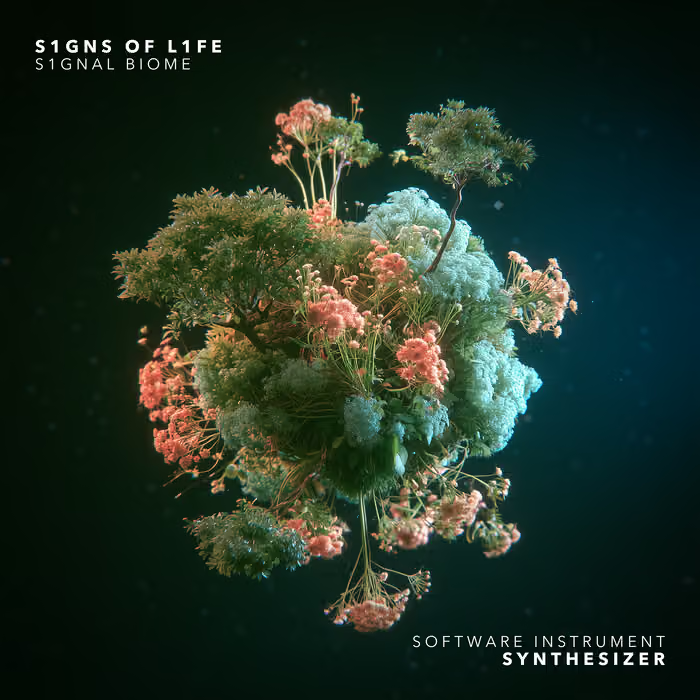
S1GNAL B1OME

S1GNAL B1OME is a polyphonic drone synthesizer designed for evolving harmony, suspended textures, organic movement, and immersive ambient sound design. From its living Atlas and deep editing system to Motion and the expansive Airglow Space engine, it was built to turn simple chords into rich, evolving sound worlds.

The video explainer…

Stellarizer

Stellarizer is a performance-driven MIDI sequencer built to turn notes into evolving, editable, export-ready musical ideas.

Capture a phrase, import a MIDI clip, build one step at a time, draw notes directly, or generate a new source. Then shape timing, contour, rhythm, density, articulation, structure, velocity, duration, melody, and harmony while keeping the musical identity of the original idea intact.

Stellarizer generates MIDI rather than sound, so it can drive your favorite software instrument, sampler, drum machine, or external hardware. It is equally at home evolving a bass line, reshaping a lead, breaking apart a chord progression, building generative patterns, or helping you escape a creative rut.

Again, what Chris has designed I can’t understand technically. But it is a fascinating way to take a MIDI file and produce interesting patterns and sequences.

Available from Gumroad for $26

Glitchwork

Glitchwork is a FM Grid percussion instrument by S1gns Of L1fe, built for sharp glitch hits, broken digital pulses, modular-adjacent rhythm patterns, and cinematic micro-percussion.

At the center is a continuous two-dimensional FM Grid. Move through it to find metallic ticks, dusty transients, clean pitched blips, gritty broken sines, short FM bursts, and unstable rhythmic fragments. Each step in the sequencer can remember its own grid position and sound settings, so patterns are not just triggers. They become sequences of timbre, movement, decay, pitch, probability, ratchets, and tone.

Not really the sounds I would normally use. However, this could be used sparingly to add some rhythmic elements.

Works well with the orbital sequencer.

Available from Gumroad for $50.

Orbital Sequencer

Orbital Sequencer is a scale-locked MIDI sequencer that turns step sequencing into a circular, performance-friendly instrument.

Its eight-orb interface makes it fast to shape duration, pitch, velocity, octave, and mute states while the sequence stays locked to your DAW’s transport and tempo.

I have no idea what all that means. All I know is that if I hit enough buttons it will output some interesting patterns. And by recording the MIDI, getting something that can be a start for a track.

Available from Gumroad for $14

Texture Loom

Texture Loom 1.5 is a free dual-source sample and granular instrument by S1gns Of L1fe. Turn field recordings, vocals, guitar, synths, noise, and found sound into evolving pads, drones, cinematic beds, and playable clouds.

Load two samples. Choose conventional playback or granular synthesis for each source. Blend them, set them in motion, sculpt their tone, and let them bloom into stereo space.

This instrument works well, providing interesting variations for short samples. The only issue I have is that the modulation routes are in a big, predetermined list of 27. It would have been better to have a modular grid of smaller icons. That way you could see at a glance what was active

It is available from Gumroad for about $8.

Another handy instrument.

Man Dead

A Man Lay Dead by Ngaio Marsh (1934)

This is her first novel and it features Detective Roderick Alleyn.

The plot concerns a murder committed during a detective game of murder at a weekend party in a country house.

There is some good prose writing here, clear and concise with the book coming in at 50,000 words.

A classic style, heavily influenced by Agatha Christie. Only let down by a rather convoluted murder method.

As The Illustrated London News, reviewed:

“A Man Lay Dead,” by Ngaio Marsh, imports a real murder into the “murder” game. The reconstruction of the crime is ridiculous; sliding down the banisters should have been left to the nursery. The hue-and-cry is good enough, and the author has spared no effort to keep his trailers off the scent as long as possible.

Mackintosh

The Mackintosh Man (1973)

Based on “The Freedom Trap”

Despite it’s stars, Paul Newman and James Mason, and director John Huston nothing could save this film.

Although based on the novel, scriptwriter Walter Hill wrote 90% of the first half, various people wrote the rest. So the explosive ending in the book is replaced with a brief chat and some killings.

The only ‘action’ scene of note is a car chase with obvious back screen projection.

A real dissapointment.

Free Traps

The Freedom Trap by Desmond Bagley (1971)

Joseph Rearden is a better-than-average crook with a jail conviction on his record. In London, he is hired by a man known only as Mackintosh, assisted by his secretary Mrs Smith, to steal a consignment of diamonds. The theft is successful but Reardon is almost immediately arrested.

So begins another of Bagley’s best. With its convoluted plot, you never know where it’s going. It could have been the basis for a James Bond film.

In 1973, it was made into a film entitled The Mackintosh Man, starring Paul Newman.

Apocaloptimist

The AI Doc: Or How I Became an Apocaloptimist


2026 American documentary film directed by Daniel Roher and Charlie Tyrell.

Told through the perspective of filmmaker Daniel Roher as he prepares to become a father, the film investigates the existential threats and potential promises of artificial intelligence. Roher conducts interviews with leading experts in the field to understand the world his child will inherit, balancing anxiety with “apocaloptimism”.

Interviewees

An extensive look at the AI landscape. The main thing missing is the financial ramifications of this bubble bursting. But for that, see Ed Zitron.